
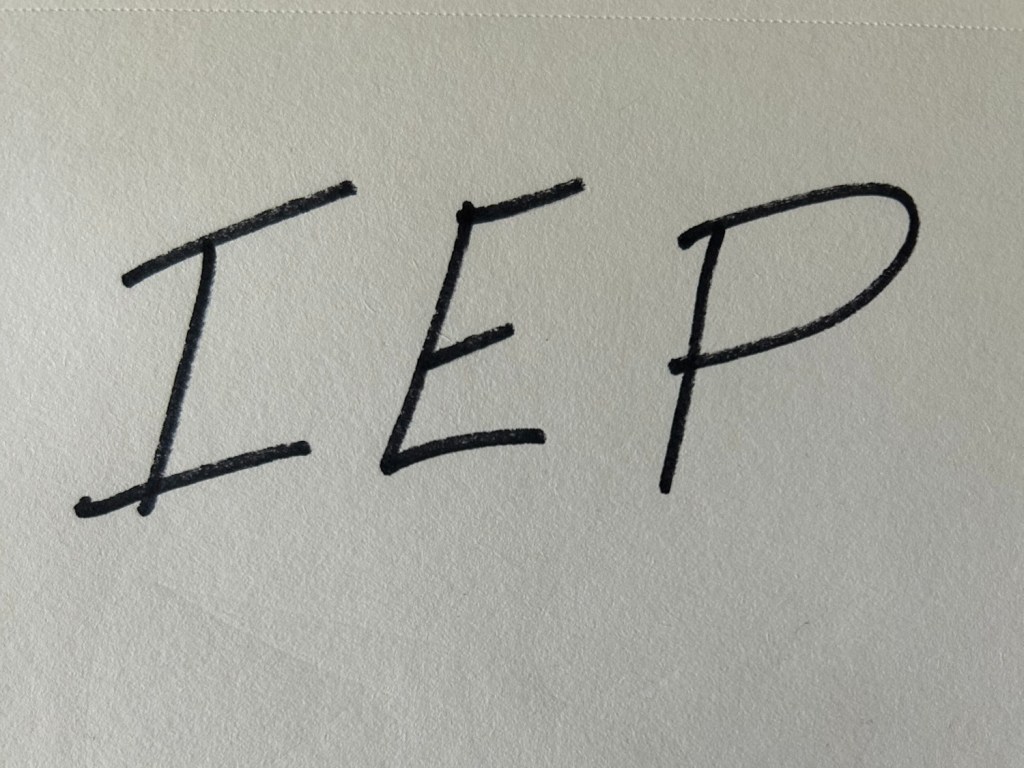
It’s the end of the school year and how is your child’s IEP looking? Feeling good or not so great about it? IEP (Individualized Education Plan) is a detailed plan of how the school will implement supports, accommodations, and services for your child to access the curriculum that is necessary for success in the classroom. Sounds straight forward, right? Not so much. There can be obstacles.
I am not an expert when it comes to Special Education nor am I an Advocate. However, I am a parent whose children are in Special Education and both have IEP’s. This is not a comprehensive list but as a parent I want to share a few things that I have learned about the IEP process.
Getting your child an IEP can come with mixed emotions. It may be the first time you are confronted with the significance of your child’s delay. It may be the first time you have ever heard about an IEP and have a lot of questions. It may bring up feelings of your own academic struggles that you would like to forget. Take a deep breath because I hope what you read next may help a little bit.
Things to know about the IEP process.
I’ve had experience with both good IEP meetings and terrible ones but a few things are generally true:
- The IEP is a legally binding document.
- It is extremely hard to get a 1:1 aide.
- Sometimes you will be asked to make a graduation determination early. This mainly has to do with programming and which form of the curriculum your child will access. For example, you may be asked if your second grader will be working towards a diploma or certificate upon graduation.
- Always check the Supplementary Aids, Services, Program Modifications and Supports section. Make sure it is for the entire academic year.
- Document everything!!!!! Document the disagreements in the Prior Written Notice or end of meeting notes.
- Emphasize team work. If you feel as if you are being pushed out, speak up. Always ask for clarification if you don’t understand something.
- Pursue all manner of complaint through the proper channels if you see that the IEP is being violated or not implemented.
- You may have to hire an Advocate but it does not guarantee you will receive the outcome that you want. We hired an Advocate for our oldest son to get a school transfer to a non-public private special needs school for the following school year. He was not transferred until 2 years later. Needless to say, our timeline and the actual time it took to get him transferred was not the outcome we were expecting. However, Advocates can also make a positive difference and sometimes showing up with an Advocate gets the schools attention and they may be more accommodating or willing to correct any errors in their implementation.
- IEP’s are not forever but they certainly should remain in place until all stated goals are achieved.
- You may not get ESY – Extended School Year. ESY is different from Summer School. Summer School is enrichment and ESY is real academic work so that there is not a regression during the time off. If your school is recommending Summer School ask them to clarify what that means. Maybe your child just needs that enrichment but if you are worried about academic loss, ESY is what you want!!
- 15 minutes of Speech or Occupational Therapy is never going to be enough but it may be all that the school can offer. There just isn’t enough staff to go around.
- You have a right to receive a draft IEP 5-10 days before the meeting. If you receive a surprise draft on the day of the meeting you have the right to refuse the meeting at that moment and request a new one so that you have time to read over the draft IEP.
- If you don’t like it DO NOT SIGN IT. Some IEP’s need more discussion and mediation to reach a resolution.
- Make sure you have measurable goals on the IEP. “Johnny will count to 10 by November” is not a measurable goal. It should read “Johnny will be able to count numbers 1-10 in 3 out of 4 trials consistently by the end of the first quarter”. This shows how many numbers Johnny needs to count, the frequency he needs to show his understanding of what he has learned and an end date. The devil is in the details.
- You can request an IEP meeting at any time.
Budgets
I want to address something that really does affect Education as a whole and that is the budget. There never seems to be enough funding available.
I recently experienced a change in provider support due to budget constraints. My youngest son receives support from a 1:1 aide in the classroom. It was very hard to get him this support after presenting the administration with several points of data that his teacher took during the second half of last year. The school finally relented and requested a highly trained 1:1 aide after repeated behavioral instances and little to no academic progress. Once he started working with his 1:1 aide everything turned around. This was truly one of the best decisions that was made to help my son. He needed that support.
Then about a month ago I was told that the county did not renew its contract with the facility that provided the 1:1 aide. When I asked why they told me that they did not know. I ended up talking to the Office of Special Education and was told that it was a budget issue. Hmm. Dead End.
Needless to say, I am not happy that there is no money in the budget to continue this wonderful support for my son and the other children in our school system who receive it. I feel lucky that the current 1:1 is training his new 1:1. I’m believing that things will go well, but would have preferred a little heads up from the higher-ups about this decision. I feel it should have been more transparent and not something I had to search for to get an answer.
Perhaps with some parental input, they would have considered how the bond that a child and their 1:1 aide develops is unique, and severing that bond should be avoided at all costs. Yes, he will still have a 1:1 and will eventually bond with the new one but creating bonds of friendship and affection can be hard for kids with Autism. Anyways, that’s my two cents.
Conflicts
At some point, you will have conflicts about your child’s IEP. Usually, the conflict occurs when the whole child’s wellbeing is not taken into consideration and the school only teaches to the diagnosis. For example, you may know that your child needs frequent breaks. The school may also know that your child needs frequent breaks. Your idea of a frequent break is once every 5 minutes. The school may consider giving a break once a task is completed. That is not taking the actual needs of the child into consideration but rather it bases it on task completion.
Another example, is a child may be learning math and reading through discrete trials (repetitious learning until a skill is mastered). This can get boring. Teaching the concepts around math and reading may be where the child understands what is expected.
For example, a child may need to work on their math skills. You can practice this by having the child count the forks they need to set the table. If it’s too many you can teach them to subtract the amount not required for the proper place setting and vice versa. Right there you have a real world opportunity to practice adding and subtracting that is not abstract.
Developing the concepts or reasons why something is done a certain way may be the better approach for how the child learns, but the schools programming may not support that. That can create conflict.
I’ll wrap this up
Over the years I have learned a lot about the IEP process. It’s not all doom and gloom but it’s not exactly easy either. Most teachers and school administrators want your child to succeed. Sometimes the School District gets in the way of that success and, unfortunately, there are hinderances that can make this process more difficult than it needs to be.
I believe teamwork, transparency, creativity and advocacy can help students achieve their academic goals on their IEP’s. I am lucky my children attend school’s, both private non-public and public, that understand and support their way of learning. They have always been open to my suggestions and I truly feel that we are a team.
I hope this helps a little bit if you find yourself faced with an IEP. I would also love to know your experiences or suggestions about the IEP process. Let me know in the comments!
Take care,
Heather


 This Autism Journey
I would love to hear from you. Please leave a comment.